NCERT Class 8 textbook: Hitler dropped, Congress stance on Partition tweaked
The revised edition adds Savarkar to the independence narrative and now lists economic background as a ground for discrimination.
PTI
-
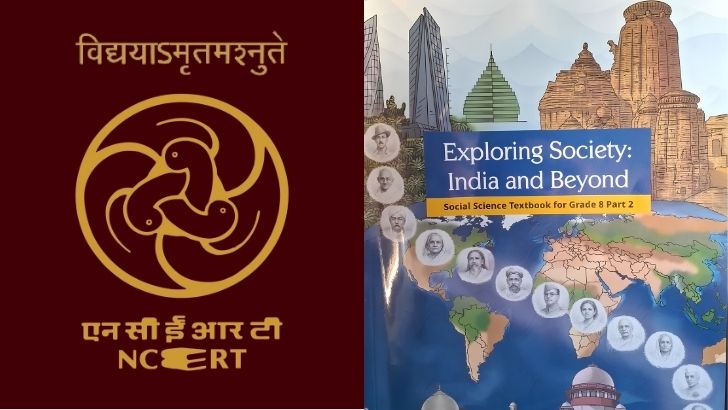
While Savarkar's demand for Swaraj has been added in the textbook, the references to Adolf Hitler have been dropped (Representative image)
New Delhi, 8 July
The NCERT class 8 social science textbook which was revised following a controversy for allegedly defaming judiciary has more corrections -- a tweaked version of Congress' position on Partition in 1947 saying its acceptance as the only way forward remains a matter of debate.
While VD Savarkar's demand for Swaraj has been added in the new textbook, the references to Adolf Hitler and Nazi ideology have been dropped.
Months after it stoked a controversy for allegedly defaming the judiciary, the National Council of Educational Research and Training's (NCERT) this week released the revised class 8 social science textbook -- "Exploring Society: India and Beyond" -- dropping the disputed portions.
The controversial portions along with references to judicial backlog and two major court verdicts have been dropped while fresh material on Public Interest Litigation (PIL), tribunals and alternative dispute resolution mechanisms has been added in the revised textbook.
However, these are not the only changes made in the revised edition.
The history chapter titled "India's Long Road to Independence" says Partition was "widely opposed even by the Indian National Congress" and that whether accepting it was "the only way forward" remains a matter of debate.
The new edition also removes a sentence from the earlier textbook that said "the Congress leaders were helpless as communal massacres engulfed the subcontinent during Partition".
The now withdrawn textbook stated that "taking advantage of the disagreements between Hindu and Muslim leaders, the British decided to divide India and although Mahatma Gandhi and most Congress leaders opposed Partition they ended up accepting it as the only way forward".
The revised textbook also expands the story of the demand for complete independence by adding that "a similar demand for Swaraj was expressed by VD Savarkar in 1925".
While the withdrawn text said Netaji Subhash Chandra Bose sought Hitler's support to raise an army and described the German leader as a "dictator whose racist Nazi ideology and expansionist goals" had triggered the Second World War".
The revised edition instead states that Bose "sought support from the anti-British forces", removing references to Hitler and Nazi ideology.
After the controversy over the judiciary portion in February, the Supreme Court intervened and physical and digital copies of the textbook were withdrawn and the NCERT issued an apology.
The top court imposed a "complete blanket ban" on any further publication, reprinting or digital dissemination of the said textbook, saying it contained "offending" content on corruption in the judiciary.
The revised textbook states in its acknowledgements that it has been published pursuant to the review process undertaken "in compliance with the directions of the Supreme Court" in suo motu writ petition (civil) no. 1/2026.
It adds that Chapter 4, "The Role of the Judiciary in Society", was "rewritten" by an expert committee constituted by the Union Ministry of Education following the directions of the apex court through an order dated March 16.
The revised textbook also expands the definition of discrimination. In the chapter titled 'Citizenship: Rights and Duties', the textbook states that discrimination includes mistreating any person or group because of their "caste, religion, ethnicity, disability, race, physical appearance, gender, sexuality, or economic background", describing it as both "unethical" and "legally prohibited."
The withdrawn textbook listed 51 members as part of its development team. The revised edition lists 48, with the names of three persons -- Michel Danino, Suparna Diwakar and Alok Prasanna Kumar -- who were initially held responsible for the chapter, dropped.
Share Now

Leave a Reply
Your email address will not be published. Required fields are marked *
Other Stories
.jpg)
.jpg)