Bangladesh's first post-uprising election is test for democratic norms, minority rights
Voters hope the poll will restore democratic norms after years of disputed elections.
PTI
-
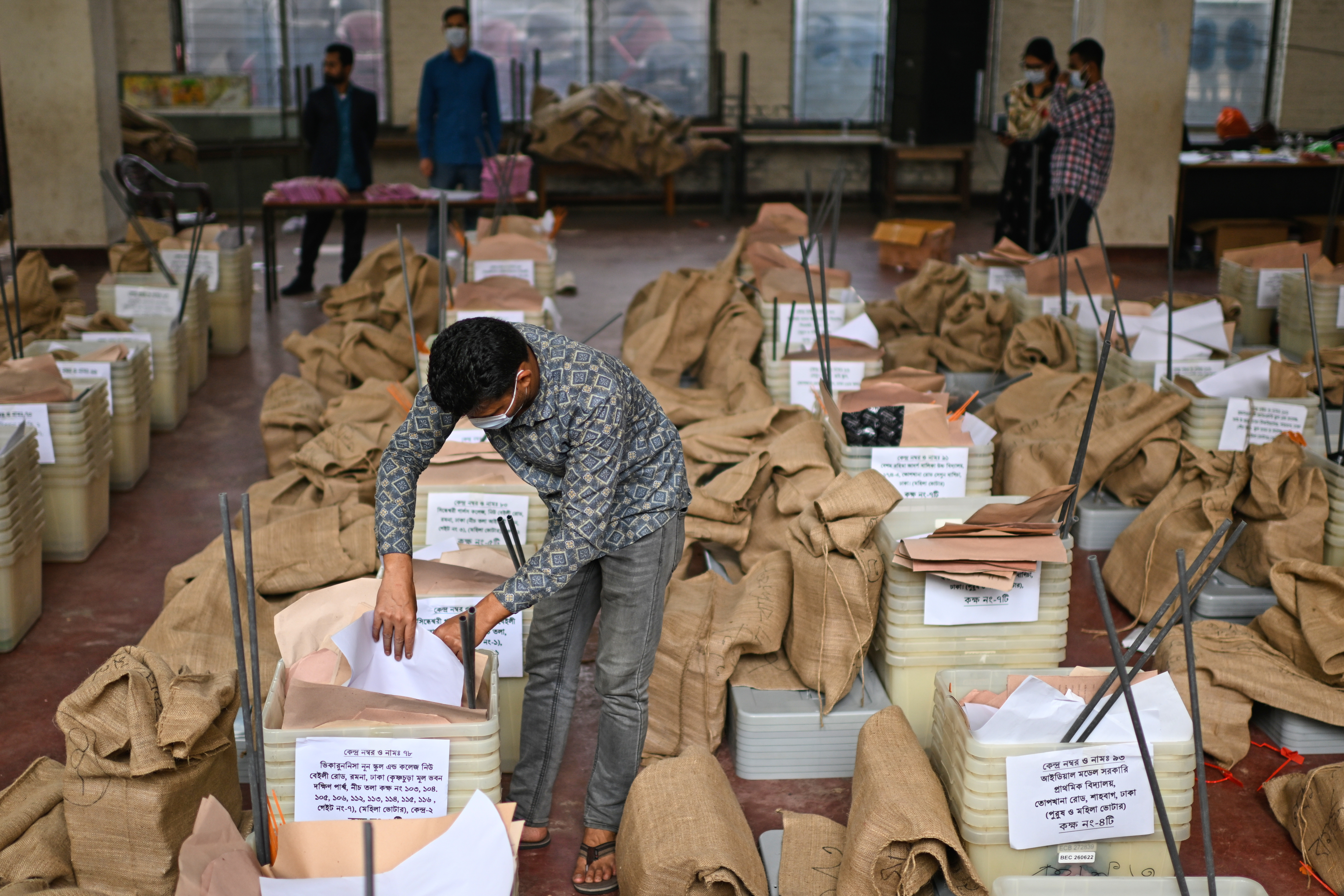
An official checks ballot boxes and voting papers before its distribution to various polling centers ahead of the national parliamentary election (PTI)
Dhaka, 11 Feb
Bangladeshis will cast ballots on Thursday in a crucial national election, the first since a mass uprising ended the 15-year rule of former Prime Minister Sheikh Hasina.
Public expectation is running high that the vote could help reset democratic norms after more than a decade of disputed elections and shrinking political space.
The
transition is being overseen by an interim administration led by Nobel Peace
Prize laureate Muhammad Yunus, which has pledged a fair vote.
Here's
what to know about the polls in Bangladesh.
The election is being closely watched
--------------------------------------------
The
election of a new Parliament will involve more than 127 million eligible voters
in the nation of some 170 million people, with 1,981 candidates contesting
parliamentary seats nationwide. The Yunus-led administration has stated that it
is committed to holding elections that are free, fair and peaceful. To help
ensure this, around 500 foreign observers will be present, including those from
the European Union and the Commonwealth, to which Bangladesh belongs.
The vote
also introduces a significant procedural change. Bangladeshi citizens living
abroad will be able to participate through a postal voting system for the first
time. The move is intended to broaden electoral participation by including the
country's large expatriate population.
Bangladesh's
national legislature comprises 350 lawmakers. Of these, 300 are elected
directly from single-member constituencies, while an additional 50 seats are
reserved for women. Elections are conducted under a first-past-the-post system,
and each Parliament serves a five-year term.
Polls are a test for Bangladesh's democracy
--------------------------------------------------
The
election will also include a referendum for political reforms that include
prime ministerial term limits, stronger checks on executive power and other
safeguards preventing parliamentary power consolidation.
Whether
the process delivers genuine institutional reform or continues to support
existing power structures will shape Bangladesh's domestic stability, which has
been marked by periods of military rule and weak democratic structures since
its independence from Pakistan in 1971.
“The
future of Bangladesh is in the hands of its citizens and elected leaders to
ensure the country's stability as a rights-respecting democracy,” said
Catherine Cooper, staff attorney at the Robert & Ethel Kennedy Human Rights
Centre.
She said
it is critical that the newly-elected government “prioritise and protect civic
space, allowing civil society, the press, political opposition, and all
citizens to speak without fear of repression.”
The
election results will also serve as an important test of whether popular
protest movements by young people can translate into durable democratic change.
Nearly 5 million people are new voters and will be casting their ballots for
the first time.
Zia's
son is expected to make a mark
---------------------------------------------
Bangladesh's political landscape has for decades revolved around two rival dynasties. On one side is the Awami League, headed by Sheikh Hasina, the daughter of the country's founding president.
Opposing it is the Bangladesh Nationalist Party, now led by
Tarique Rahman, son of former Prime Minister Khaleda Zia, who died in December.
With the
Awami League banned, the BNP has emerged as the front-runner, positioning
Rahman as the leading candidate.
Rahman
returned to Bangladesh in December after 17 years in self-exile and has
promised to rebuild democratic institutions, restore the rule of law and revive
the economy.
Challenging
the BNP is a broad 11-party coalition spearheaded by the Islamist
Jamaat-e-Islami, which is seeking to expand its influence in national politics.
Jamaat-e-Islami was banned under Hasina but has gained influence since her
ouster.
The
alliance also includes the newly formed National Citizen Party, created by
leaders of the 2024 uprising.
First
elections without Hasina in decades
-----------------------------------------------
The
election is going to be the first since the ouster of Hasina, who now lives in
exile in India. She was sentenced to death in absentia last year by a special
tribunal under the Yunus-led administration. The charges against her relate to
crimes against humanity over the deaths of hundreds of people during the 2024
uprising.
Hasina
has denounced the trial, terming the court a “kangaroo court.” In an interview
with The Associated Press from her exile in India, she denounced the decision
to exclude her party from taking part in the election.
During
Hasina's rule, elections were widely criticised by opposition parties and
rights groups as lacking credibility.
Minority Hindus feel intimidated
---------------------------------------
An
increasingly urgent concern in Bangladesh is the rising prominence of hard-line
groups. Their influence has raised alarms about the rights and safety of women
and religious minorities. Minority communities, particularly Hindus, report
increased intimidation and incidents of violence, deepening fears about their
place in the Muslim-majority nation.
There
are growing concerns that the Islamist coalition could exploit these tensions
to reassert political influence.
Bangladesh
is over 90 per cent Muslim, while around 8 per cent are Hindu.
Share Now

Leave a Reply
Your email address will not be published. Required fields are marked *
Other Stories