Karnataka budget 2026-27: CM Siddaramaiah presents his 17th State budget
CM said Karnataka remains at the forefront of national development and is among the country’s largest contributors to taxes.
PTI
-
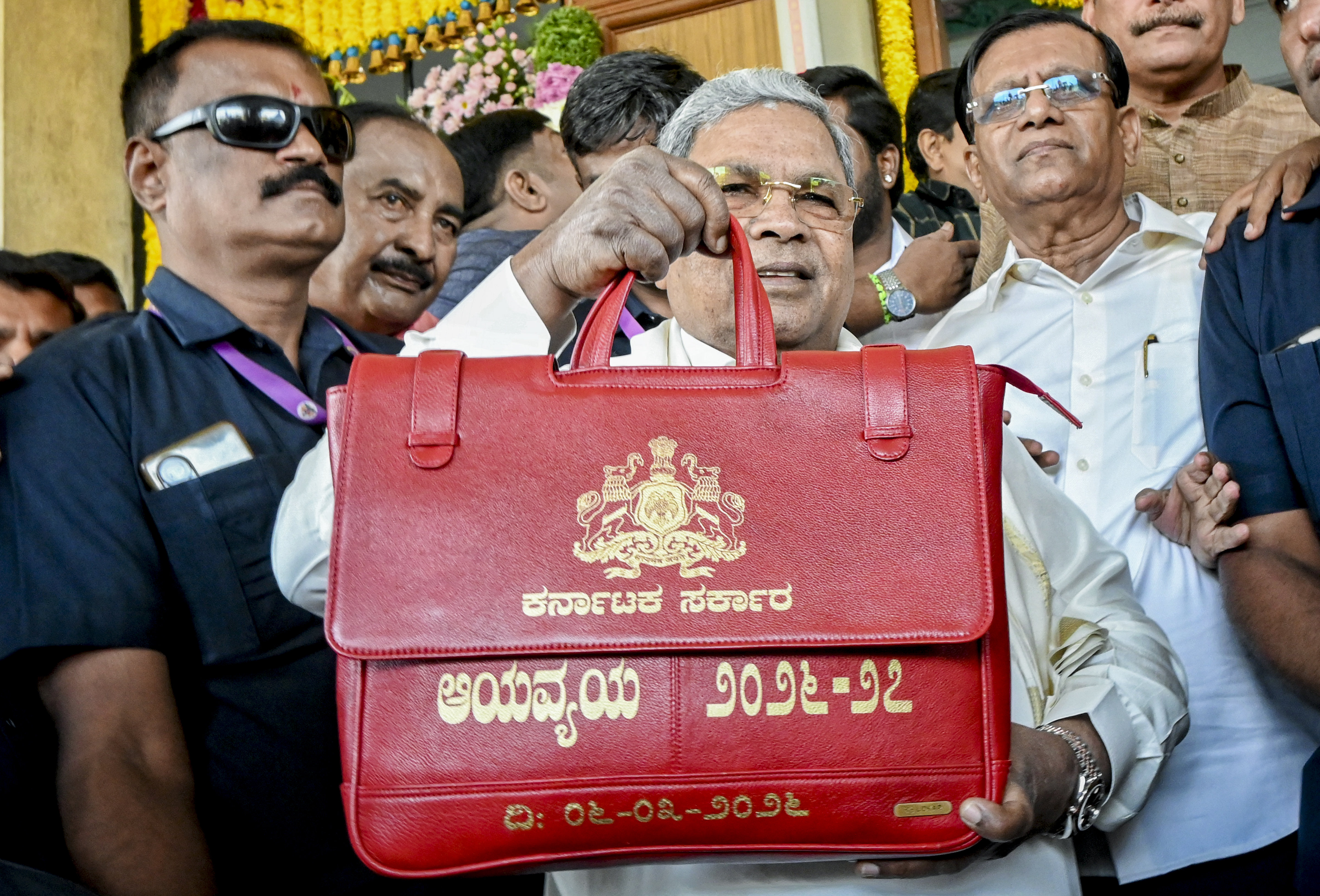
CM Siddaramaiah holding the finance portfolio, arrives to present the State Budget for the financial year 2026-27 (PTI)
Bengaluru, 6 March
Karnataka Chief Minister Siddaramaiah on Friday presented his record 17th budget, pegging the state's total expenditure for FY 2026-27 at over Rs 4.48 lakh crore, while stressing that the government was pursuing a development strategy that balances welfare programmes with investments in infrastructure and long-term economic transformation.
Lashing
out at the BJP-led NDA government at the Centre, he said that by not adhering
to the federal system of governance as per the Constitution, the former was
doing "injustice" to Karnataka.
His
government was pursuing a development strategy that balances welfare programmes
with investments in infrastructure and long-term economic transformation, and
urged the Union government to be more sensitive to the state's demands.
In his
budget speech, Siddaramaiah said Karnataka remains at the forefront of the
nation's development and is among the largest contributors of tax revenues to
the country.
Among other things, he reaffirmed the state's commitment to pursuing the Mekedatu balancing reservoir project on the Cauvery and announced a social media ban for children under 16.
"Our
state is at the forefront in all sectors of the nation’s development; it is one
of the key states that contributes the highest tax revenues,” he said.
Total
expenditure for 2026-27 is estimated at Rs 4,48,004 crore, Siddaramaiah said.
This is the 17th budget that he presented in his political career.
Drawing
an analogy from the epic tradition, the chief minister said, "The cow that
yields abundant milk requires proper care. It is Bheeshma’s philosophy that if
it becomes weak, the entire cowherd suffers".
He said
the Union government should recognise this and respond sensitively to the
state’s demands. Siddaramaiah also emphasised the importance of cooperative
federalism for a diverse country like India.
"A
nation like India, with its diverse cultures, can achieve development only
through a cooperative federal system,” he said.
Highlighting
the government's flagship welfare initiatives, the chief minister said the
Congress government prioritised economic security and social stability soon
after coming to power in 2023 through the Guarantee Schemes, which are based on
the concept of universal basic income.
"Major
studies in India and abroad show that these schemes are improving the financial
condition of crores of families and increasing people’s purchasing power,"
he said.
At the
same time, Siddaramaiah said the government has also focused on capital
investment, infrastructure development and long-term economic transformation.
Citing economist Amartya Sen, he said economic development that neglects
investment in human development is not only unstable but also unethical.
"We
are investing in welfare schemes for the people with this understanding,"
he said.
The
chief minister said the government is developing a Karnataka-specific economic
framework described as the '11G model' to guide the state’s growth.
According
to him, the model includes components such as a guarantee economy promoting
welfare and gender equality; good public education aimed at universal access to
quality education; good health for all through comprehensive healthcare; a
grassroots economy focused on agriculture and rural development; and good
governance through people-friendly administration.
He also
said that the model incorporates gig economy initiatives for labour welfare;
Geographical equality to reduce regional disparities; a global trade economy to
promote trade and industry; a tourism-driven, globe-trotting economy; a green economy
encouraging renewable energy and environment-friendly activities; and a growing
urban economy supporting sustainable urban growth.
"These
economic principles form the basis on which we are steering the chariot of the
state’s development," Siddaramaiah said, adding that the finance
department’s budget documents elaborate on how the framework defines
Karnataka’s unique development model.
Siddaramaiah
accused the Centre of treating Karnataka unfairly by disregarding the
constitutional principles of cooperative federalism.
"Reduced
Central share in centrally sponsored schemes, discriminatory allocation in
Central Sector schemes, injustice due to 15th Finance Commission's revenue
sharing formula, non-implementation of special grants, recommended by the same
commission and the untimely rationalisation of the GST rates have all led to
additional burden and pressure on the state exchequer," Siddaramaiah said.
Centre
"systematically" weakened the Mahatma Gandhi National RuralEmployment Guarantee Act (MGNREGA).
Siddaramaiah
said a weak rural employment scheme threatens the people's right to employment
and increases the financial burden on states.
"Under
such circumstances, everyone must unite across party lines to safeguard the
interests of the state and assert its rightful claims," the CM said.
He also
said that rate restructuring resulted in reduced GST collections by Rs 10,000
crore for the current fiscal year in Karnataka, and there will be a reduction
of Rs 15,000 crore next year.
Siddaramaiah
further said that Karnataka continues to demonstrate strong fiscal performance
and robust revenue mobilisation capacity. Despite structural challenges due to
the Centre's tax policy changes, Karnataka's own revenue collection exhibited
resilience, he claimed.
Share Now

Leave a Reply
Your email address will not be published. Required fields are marked *
Other Stories
.jpg)
.jpg)