Nikkei 225 soars as Japan PM Takaichi wins landslide mandate
Takaichi's first major task when the lower house reconvenes in mid-February is to work on a budget bill, delayed by the election.
PTI
-
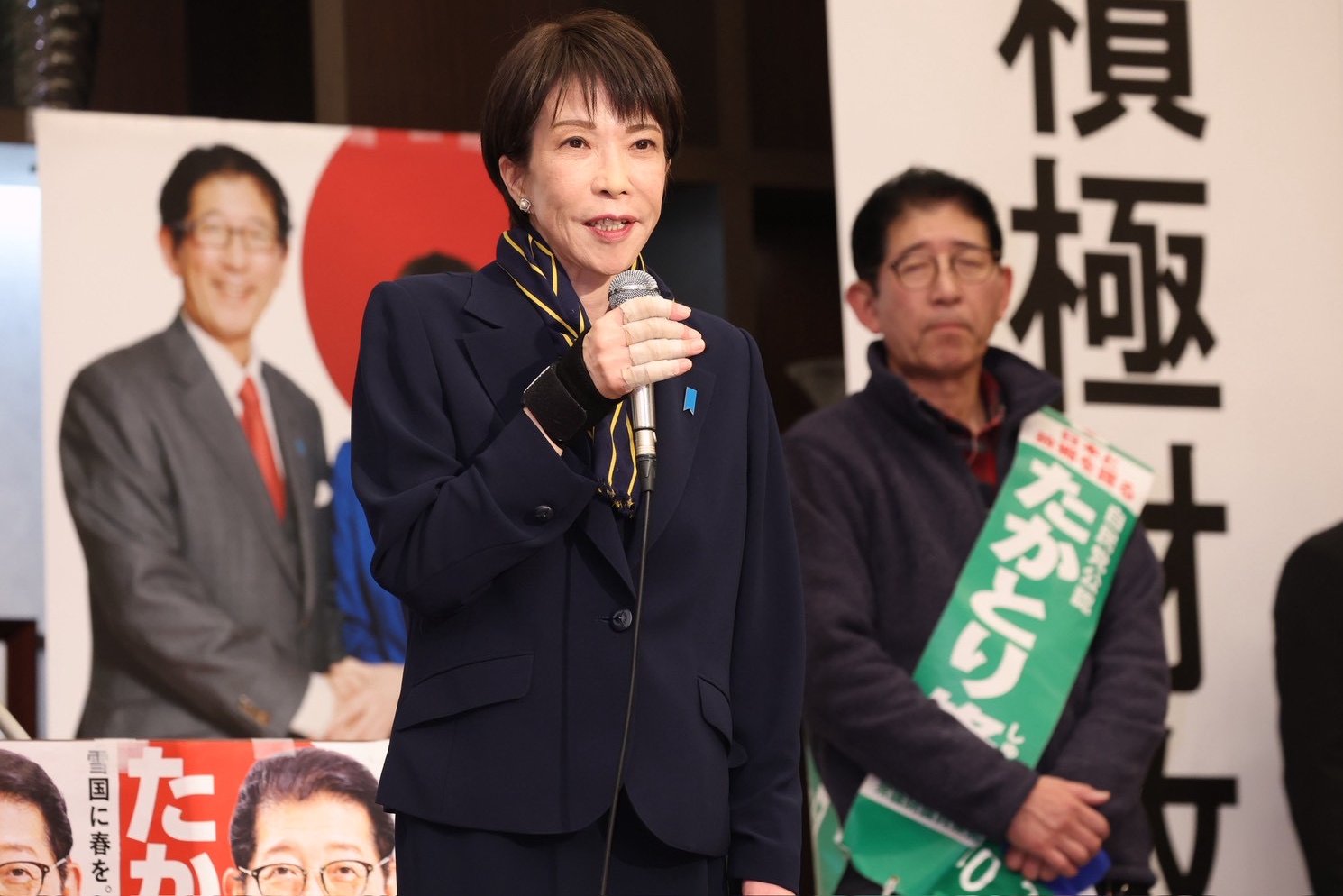
Landslide win boosts Sanae Takaichi’s reform mandate, but yen and bond markets may face pressure (X/@takaichi_sanae)
Bangkok, 9 Feb
Tokyo's Nikkei 225 share index jumped as much as 5 per cent to a record on Monday after Japanese Prime Minister Sanae Takaichi's governing party secured a two-thirds supermajority in a parliamentary election.
The
landslide victory gives Takaichi a much stronger mandate to pursue
market-friendly policies, though the impact on Japan's currency and bond
markets may not be quite so positive.
"So
overall, as the LDP has gone from a very weak government that really couldn't
do anything to an extremely strong government now with the supermajority of the
lower house, they really could call the shots,” said Neil Newman, managing
director and head of strategy at Astris Advisory Japan.
Other markets
across Asia also advanced, with South Korea's Kospi surging 4 per cent and some
other benchmarks gaining more than 1 per cent.
US
futures edged higher after the US stock market roared back on Friday as
technology stocks recovered much of their losses from earlier in the week and
bitcoin halted its plunge.
The
S&P 500 rallied 2 per cent for its best day since May. The Dow Jones
Industrial Average soared 1,206 points, or 2.5 per cent, and topped the 50,000
level for the first time, while the Nasdaq composite leapt 2.2 per cent.
The
combination of a rebound in tech shares, Wall Street's rally and other upbeat
news lifted shares early Monday.
NHK,
citing results of vote counts, said Takaichi's Liberal Democratic Party, or
LDP, alone secured 316 seats by early Monday, comfortably surpassing a 261-seat
absolute majority in the 465-member lower house, the more powerful of Japan's
two-chamber parliament. That marks a record since the party's foundation in
1955 and surpasses the previous record of 300 seats won in 1986 by late Prime
Minister Yasuhiro Nakasone.
Takaichi's
first major task when the lower house reconvenes in mid-February is to work on a
budget bill, delayed by the election, to fund economic measures to address
rising costs and sluggish wages.
“Japan
just delivered the kind of election result markets instinctively embrace
because it removes the one thing traders price at a premium: political
ambiguity,” Stephen Innes of SPI Asset Management said in a commentary.
“Politically,
the win hands Prime Minister Takaichi freedom of movement and removes the need
to bargain every decision down to the lowest common denominator,” he said.
By mid-afternoon,
the Nikkei 225 was up 4.6 per cent at 56,729.51, having topped 57,000 for the
first time to set a new record.
The
dollar weakened slightly against the Japanese yen, trading at 156.62 yen, down
from 157.10 yen late Friday.
In
Seoul, the Kospi gained 4.2 per cent, to 5,301.36, buoyed by strong buying of
tech shares.
Hong
Kong's Hang Seng index climbed 1.7 per cent to 27,007.81, and the Shanghai
Composite index rose 1.3 per cent to 4,117.57. Taiwan's Taiex gained 2 per
cent.
In
Australia, the S&P/ASX 200 surged 1.9 per cent to 8,870.10.
US
futures edged higher early Monday, with the contracts for the S&P 500 and
the Dow industrials up 0.1 per cent.
On
Friday, computer chip companies helped drive the widespread rally, and Nvidia
jumped 7.8 per cent to trim its loss for the week, which came into the day at
just over 10 per cent. Broadcom climbed 7.1 per cent and erased its drop for
the week.
But even
with Friday's surge, the S&P 500 still fell to its third losing week in the
last four. Apart from worries about spending by Big Tech companies, which are
Wall Street's most influential stocks, concerns about AI potentially stealing
customers from software companies also hurt the market. Software stocks got hit
particularly hard after AI firm Anthropic released free tools to automate
things like legal services.
Bitcoin,
meanwhile, was up 2.2 per cent following a weeklong plunge that had sent it
more than halfway below its record price set in October. It has climbed back
above USD 70,000 after briefly dropping close to USD 60,000 late Thursday.
Prices
in the metals market also calmed a bit following their own wild swings. Gold
rose 1.8 per cent to settle at USD 4,979.80 per ounce, while silver added 0.2
per cent.
In early
Monday trading, gold gained 1.5 per cent while silver was up 6.2 per cent.
US
benchmark crude oil shed 68 cents to USD 62.87 per barrel. Brent crude, the
international standard, gave up 71 cents to USD 67.34 per barrel.
The euro
rose to USD 1.1851 from USD 1.1814.
Share Now

Leave a Reply
Your email address will not be published. Required fields are marked *
Other Stories