




Karnataka CM Shivakumar announces AI education programme for schools in I-Day speech
The AI and coding programme was announced as part of Shivakumar’s Independence Day vision for a technology-driven “Youth Karnataka, New India”.
PTI
-
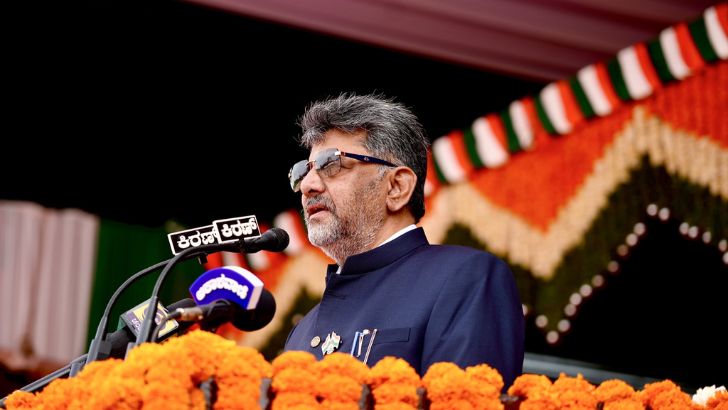
The Chief Minister also announced plans to establish India’s first government-owned AI university in Bengaluru (X)
Bengaluru, 15 August
Karnataka Chief Minister D K Shivakumar on Saturday announced the AI Akshara Abhiyana and Coding Gurukula programme to introduce artificial intelligence education in schools across the state and equip students to compete at the global level.
“We are now entering a new technological era. The AI campaign and Coding Gurukula — this is your era, a new era,” Shivakumar said in his Independence Day speech from the sprawling Field Marshal Sam Manekshaw Parade Ground here.
“Today I am announcing an important programme called the ‘AI Akshara Abhiyana and Coding Gurukula’,” he said.
The Chief Minister explained that AI education would be introduced in all schools from Class 6.
Shivakumar also said his government was working to establish India's first government-owned AI university in Bengaluru.
Stressing on the need to improve the quality of schools and colleges, the CM said an expert committee constituted to reform the examination system would submit its report within two months.
Outlining his vision for Karnataka, Shivakumar said “Youth Karnataka, New India” was his government's slogan and said the state had set a target of taking its economy to USD three trillion, or Rs 320 lakh crore, by 2047.
Karnataka's per capita income, he said, had reached Rs 4.33 lakh, nearly twice the national average, while the state ranked second in GST and income-tax collection.
He announced a number of measures focused on youth and employment, including filling around 72,000 government vacancies within six months, Udyoga Sethu for private-sector job seekers and Udyoga Nidhi. Industries creating new jobs would receive an incentive of around Rs 2,500 per job per month for two years, benefiting up to one lakh jobs.
The government would establish 10,000 Bharat Jodo Yuva Sangha across Karnataka, each receiving an annual grant of Rs 10 lakh, involving a total outlay of Rs 1,000 crore.
An Advanced Manufacturing Cluster at Doddaballapur is expected to attract around Rs 20,000 crore investment and create about three lakh jobs.
For rural students, the government would implement the Sahaya Hasta/Hosa Hasta scheme and provide 7.5 per cent reservation for students of rural government schools in professional higher education, including medicine and engineering.
In agriculture, Shivakumar announced the Chief Minister's 'Raitha Chaitanya' scheme, using drones, satellites and real-time data for crop-insurance surveys and information on pests, diseases and markets.
Under Raitha Mitra, small farmers would be able to rent agricultural machinery, while farmers owning up to three acres would get tractor ploughing at a 50 per cent subsidy.
He said Rs 1,300 crore had been paid as crop-insurance compensation, 25 lakh farmers had enrolled for crop insurance this monsoon, micro-irrigation had been expanded to two lakh hectares and 174 high-tech harvester hubs established.
A total of Rs 2,600 crore had been transferred directly to nine lakh dairy farmers, while 275 mobile veterinary units would provide services at farmers' doorsteps.
On social welfare, Shivakumar said Rs 44,631 crore had been allocated this year for SC/ST welfare and around Rs 4,000 crore for backward classes in 2026-27.
On health front, he said the maternal mortality rate had fallen by 60.19 per cent and vaccination was being provided to adolescent girls against cervical and other critical cancers.
Water security, he said, was a priority, with 112 major reservoir projects worth Rs 16,000 crore approved.
The government remained committed to starting the Mekedatu project for drinking water and farmers and had directed officials to fill lakes and tanks. The first phase of the Upper Krishna drinking-water project had been completed and was planned to be extended to Tumakuru by November.
On infrastructure, he said work had begun on 1,663 km of highways, 3,000 km of major district roads and 112 bridges. Pragathi Patha envisages upgrading 7,100 km of rural roads at Rs 5,200 crore, while Kalyana Patha covers 1,550 km.
For Bengaluru, the government has sanctioned programmes worth Rs 1.56 lakh crore, including Rs 55,000 crore for major city roads.
The Bengaluru Business Corridor, replacing the stalled Peripheral Ring Road project, will cover 117 km at Rs 26,000 crore.
He said the Namma Metro network would reach 220 km after Phase-3. The government has also created the Greater Bengaluru Authority and five municipal corporations, plans to expand the police network, establish an Anti-Rowdy Squad and improve coordination between the GBA and traffic police.
Shivakumar announced a proposed Karnataka State Motor Vehicle Insurance Corporation, saying insurance business and taxes should benefit people of the state.
He said Karnataka had approved 945 investment proposals worth more than Rs 1.34 lakh crore and attracted Rs 1.12 lakh crore in FDI during the last year.
The Bhoomi Guarantee, described as the government's sixth guarantee, will provide digital khatas to 26 lakh Bengaluru property owners at their doorsteps, while rural residents will receive khata facilities and documents through a similar programme.
On drought and rural development, Shivakumar said the government was taking measures to protect drinking-water sources, prevent migration and create jobs in backward areas.
He reiterated the government's commitment to inclusive development, saying, “Security for every family, dignity for every citizen and opportunities for the youth — these are the fundamental principles of our government.”
Share Now

Leave a Reply
Your email address will not be published. Required fields are marked *
Other Stories
.jpg)
.jpg)
