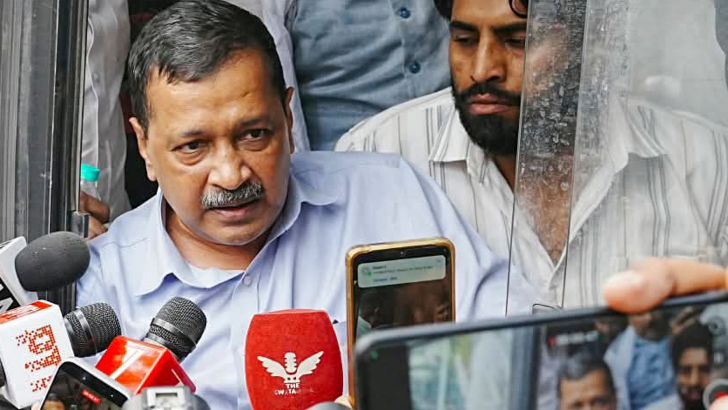
Dipke: Better to face jail than sit in Boston and be called a national security threat
Salar News caught up with CJP founder Abhijeet Dipke to find out about the genesis, the current agenda and the future plan of the ‘parody-turned-people’s movement’
On 15 May, the Chief Justice of India Surya Kant, during the course of a routine hearing, dismissed the youth of the country in rather derisive terms calling them “cockroaches” and “parasites”.
The Chief Justice had said: “There are youngsters, like cockroaches, who don’t get any employment and don’t have any place in the profession. Some of them become media, some of them become social media, some of them become RTI activists, some of them become other activists, and they start attacking everyone.”
The CJI later said his remarks were “misused with malicious intent”.
Sitting in faraway Boston, pursuing a Master’s degree in Public Relations from the Boston University College of Communication, 30-year-old Abhijeet Dipke tweeted about it. His simple, six-word question was: “What if all the cockroaches come together?”
This one sentence led to a completely unexpected, maybe even unprecedented uprising among the youth of this country in recent times. What began as a mere spoof has turned into a movement that threatens to dislodge an elected government, and its supporters have faced serious backlash from the government agencies in the form of arrests, detentions and police violence.
Salar News caught up with the man behind the movement, Dipke, to find out about the genesis, the current agenda and the future plan of the ‘parody-turned-people’s movement’, which now holds the possibility of leading a youth revolution in the country.
Salar News spotted Dipke at Bengaluru’s much-loved Corner House with members and supporters of the CJP, having a relaxed evening with some ice-cream after a day-long protest in Bengaluru.
Why all this fuss?
“I am also wondering,” pat comes his reply.
“I am still trying to figure out how this one tongue-in-cheek tweet morphed into this huge youth movement.” “But this is what life has thrown at me and I am just doing what is required of me in this current scenario.”
The viral tweet led to the creation of the Cockroach Janta Party, a satirical, youth-focused political platform, whose initial criteria for membership were: A person had to be lazy, unemployed, chronically online, glued to the internet and possess an ability to rant professionally.
“It was supposed to be a spoof,” says Dipke disarmingly. Within 24 hours, there were 5,000 members in what was then ‘this parody party.’
How long did it take you to realise that this was getting to be serious business?
“A week,” says Dipke. “The kind of response that I was getting forced me to open an Instagram account. There were a million followers within one week. And that is when it hit me that something more than simple fun was happening here.”
But he was still figuring out what to do with this huge list of followers when the next step was decided for him by the government, which decided to term him a ‘national security threat’.
The 30-year-old is suddenly filled with righteous anger as he recalls that moment. “Here I was having some online fun and suddenly they were questioning my patriotism. I love my country. I am someone who has grown up on AR Rahman’s ‘Maa Tujhe Salaam’,” he says earnestly.
“Whatever I am at this point in my life, it is because of what my country has given me. And here they were calling me a national security threat. It was then I decided that I had to come down and clarify my point. I decided that it was better to face the possibility of imprisonment than sit in Boston and be called a security threat to my nation.”
Dipke says he left Boston with mixed feelings. He was sure that he would be arrested when he landed in Delhi. “On the way to India, my thoughts were all about my family. Would I be able to meet them? If I get arrested, will I get to celebrate Diwali at home? I also wondered if there would be anyone at the protest. These were the initial thoughts running through my head.”
Dipke speaks fondly about his association with two compatriots Sourav Das and Ashutosh Ranka, he says, “Sourav and I were online friends for a couple of years but had never met each other. I respected him for his articles and was randomly in touch with him.
“When I decided to return to India, I called Sourav and told him that if I was arrested, he should speak on my behalf and tell the people what I was trying to do. Ashu (Ashutosh Ranka) on the other hand, was someone I knew for about four years.”
The three youngsters who would find themselves accidently intertwined with the history of the nation met for the first time in New Delhi in June 2026.
Dipke calls himself a private person.
“I never wanted to be a celebrity. I did not even have a large group of friends in college and I did not hang out with many people. In fact, some of my friends are upset with me and are saying ‘now you are hanging out with so many people’,” he laughs. “I did not even expect 10 people to turn up at the initial protest,” he adds.
For a reluctant leader at the helm of a people’s movement, Dipke seems to be rather well-informed about the colossal mess in the SIR process.
Speaking at the People’s Tribunal in Bengaluru, Dipke had called the government ‘One Nation, One Election just a cover for ‘One Nation One Party’. He said that people whose names had been deleted from the electoral rolls had been present at various protest evens to ‘prove’ that they were alive.
Stating numbers, Dipke said that 50,000 votes were deleted in Mamata Banerjee’s constituency, where the former chief minister lost by 15,000 votes. Similarly, around 40,000 votes were deleted in Arvind Kejriwal’s constituency, where he allegedly lost by about 4,000 votes; and one lakh in a constituency associated with Tamil Nadu CM MK Stalin, where he claimed the margin was a mere 10,000 votes. This is a pattern to eliminate regional parties and destroy the federal structure of our democracy, he said.
Dipke called the Chief Election Commissioner a threat to Indian democracy and said that his resignation was an important step in saving Indian democracy.
While riding high on his own idealism and the overwhelming support from all quarters in the country, the one thing that bothers Dipke is the fear that his family has for his safety. “My mother cries every few days. She fears that I will be arrested one of these day. I keep reassuring her that I am going to be fine. Seeing the fear in her eyes frustrates me,” he says.
Did he ever regret returning to India?
“Never,” he says categorically.
The CJP has been charged with trying to destabilise the country, to which Dipke says that he draws his inspiration from Mahatma Gandhi and calls the CJP’s movement a ‘satyagraha’ against the corrupt government and the Election Commission. Peaceful protest is not destabilising the country, beating up 15-year-olds is, he reiterates.
What is future of the CJP? Will it become a political party in the future?
“I don’t know. It is something that all of us CJP members would have to decide together. But we will remain a public pressure group. We will ask for accountability from the government. I also hope that we will see the rise of more organisations like the CJP in the near future, and together we will hold the government accountable.”
Soon it is time for the CJP chief to leave as his young team is waiting for a ‘group photo’ with him.
But there is one last question to be asked.
What do you consider CJP’s biggest achievement at this point?
“The CJP has helped the country get its voice back. That I think is our biggest achievement,” he says easily.
Share Now

Leave a Reply
Your email address will not be published. Required fields are marked *
Other Stories
.jpg)
.jpg)