
Ebola suspect from Sudan in isolation at Hyderabad hospital
The Gandhi Hospital has set up an Ebola Isolation Centre to keep the suspected patient under observation and conduct further tests.
PTI
-
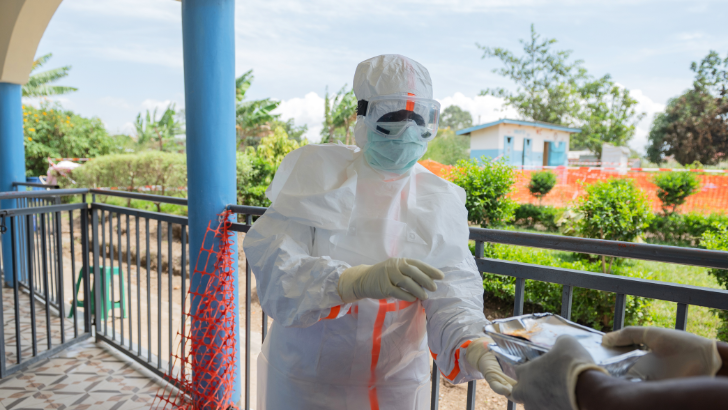
The Ebola virus is transmitted to humans from infected wild animals such as fruit bats, porcupines and non-human primates (PTI)
Hyderabad, 4 June
A Sudanese national who arrived at Rajiv Gandhi
International Airport on Thursday was shifted to an isolation centre for
further tests after exhibiting suspected Ebola symptoms, authorities said. The
passenger had recently travelled to South Sudan and Uganda.
The Airport Health Organisation had set up a screening
centre to examine all international passengers for symptoms related to the
ongoing Ebola Virus Disease outbreak reported in certain countries.
“It is not a confirmed Ebola case. The passenger has a
travel history to affected countries. It is being treated as a suspected case
because we do not yet know whether he will develop additional symptoms. Only
after testing and confirmation can he be classified as an Ebola case,” an
official told PTI.
The state-run Gandhi Hospital here has set up an Ebola
Isolation Centre to keep the suspected patient under observation and conduct
further tests.
Last month, Hyderabad Airport said in an advisory that it
was implementing enhanced public health preparedness measures in accordance
with the latest directives issued by the Directorate General of Civil Aviation
(DGCA) and the Ministry of Health and Family Welfare (MoHFW) regarding the
ongoing Ebola Virus Disease outbreak reported in certain countries.
The advisory applies to passengers arriving from or
transiting through affected regions, including Uganda, the Democratic Republic
of Congo (DRC), and neighbouring high-risk areas. Passengers arriving from or
transiting through affected countries may be required to complete a
Self-Declaration Form (SDF) before deboarding, the advisory said.
According to the WHO website, Ebola is a severe and oftenfatal disease that affects humans and other primates.
The virus is transmitted to humans from infected wild
animals such as fruit bats, porcupines and non-human primates and subsequently
spreads among people through direct contact with the blood, secretions, organs
or other bodily fluids of infected individuals, as well as through contaminated
surfaces and materials such as bedding and clothing.
Share Now

Leave a Reply
Your email address will not be published. Required fields are marked *
Other Stories