Census 2027: Enumerators to carry QR code-based identity cards amid cyber fraud concerns
Officials said recent “digital arrest” scams and fake census messages have raised fraud concerns.
PTI
-
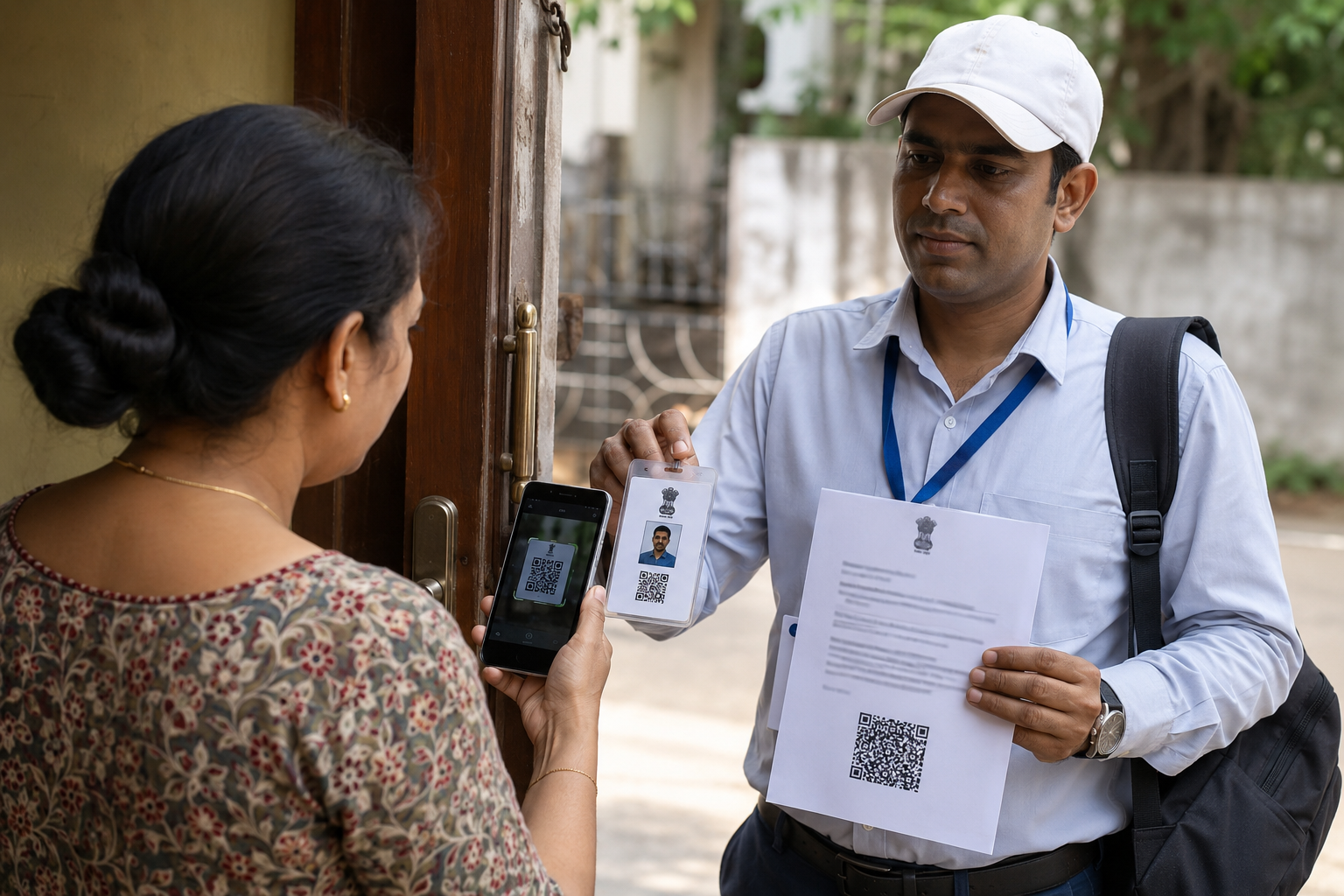
The move aims to make the door-to-door Census 2027 exercise in Delhi safer and more efficient from 16 May (AI)
New Delhi, 12 May
Amid a rise in cyber fraud cases involving impersonation and fake government officials, authorities have implemented a QR code-based verification mechanism for enumerators and supervisors visiting households for Census 2027 in the capital.
This move
aims to make the door-to-door enumeration in Municipal Corporation of Delhi
areas, beginning May 16, more secure and effective.
Officials
of the Office of the Registrar General and Census told PTI that all enumerators
and supervisors (E&S) deployed for the exercise will carry an appointment
letter and an identity card issued by the charge officer. Both documents will
have embedded QR codes that residents can scan to verify their authenticity.
"If
there is any doubt or suspicion, household members can verify the visiting
personnel by checking their appointment letter and identity card. They can also
scan the QR code printed on these documents to confirm authenticity,"
officials said.
The
safeguard comes when several cyber fraud cases have surfaced across the
country.
Fraudsters
pose as law enforcement or government officials to dupe people using fake
documents, impersonation and digital verification requests.
Officials
said recent "digital arrest" scams and fake census-related messages
circulated online have heightened concerns over impersonation-based fraud.
Officials
reported that under the ongoing self-enumeration exercise, 93,521
self-enumerations were recorded on Monday, including 77,372 completed cases and
16,149 initiated cases, resulting in an overall completion rate of 82.73 per
cent.
Officials
said most entries were registered by residents of the North East, South West,
and North West Delhi districts.
According
to officials, if a household cannot geo-tag its location with exact precision,
it may tag a nearby location instead. In such cases, the enumerator will
download the map of the concerned HLB (House listing and Housing Phase) and all
self-enumeration IDs linked to that block for verification during field visits.
During
door-to-door House Listing Operations (HLO), enumerators will ask households to
provide their self-enumeration IDs and match them with the tagged households in
the HLB.
If the
self-enumeration ID does not correspond to any listed house or building in the
block, the enumerator will collect the household details afresh.
To
strengthen oversight, one supervisor will monitor the HLO for every six HLBs.
According
to officials, the layered verification system is expected to make the census
process smoother and more reliable, while helping households navigate the
exercise with greater confidence when concerns over digital fraud remain high.
Officials
said the QR-based verification system has been designed to reassure households
and build public confidence in the enumeration process.
Share Now

Leave a Reply
Your email address will not be published. Required fields are marked *
Other Stories





.jpg)