126-member Assam Assembly to have 7 women MLAs; six of them from NDA
The NDA is set to form the government in Assam for the third consecutive term.
PTI
-
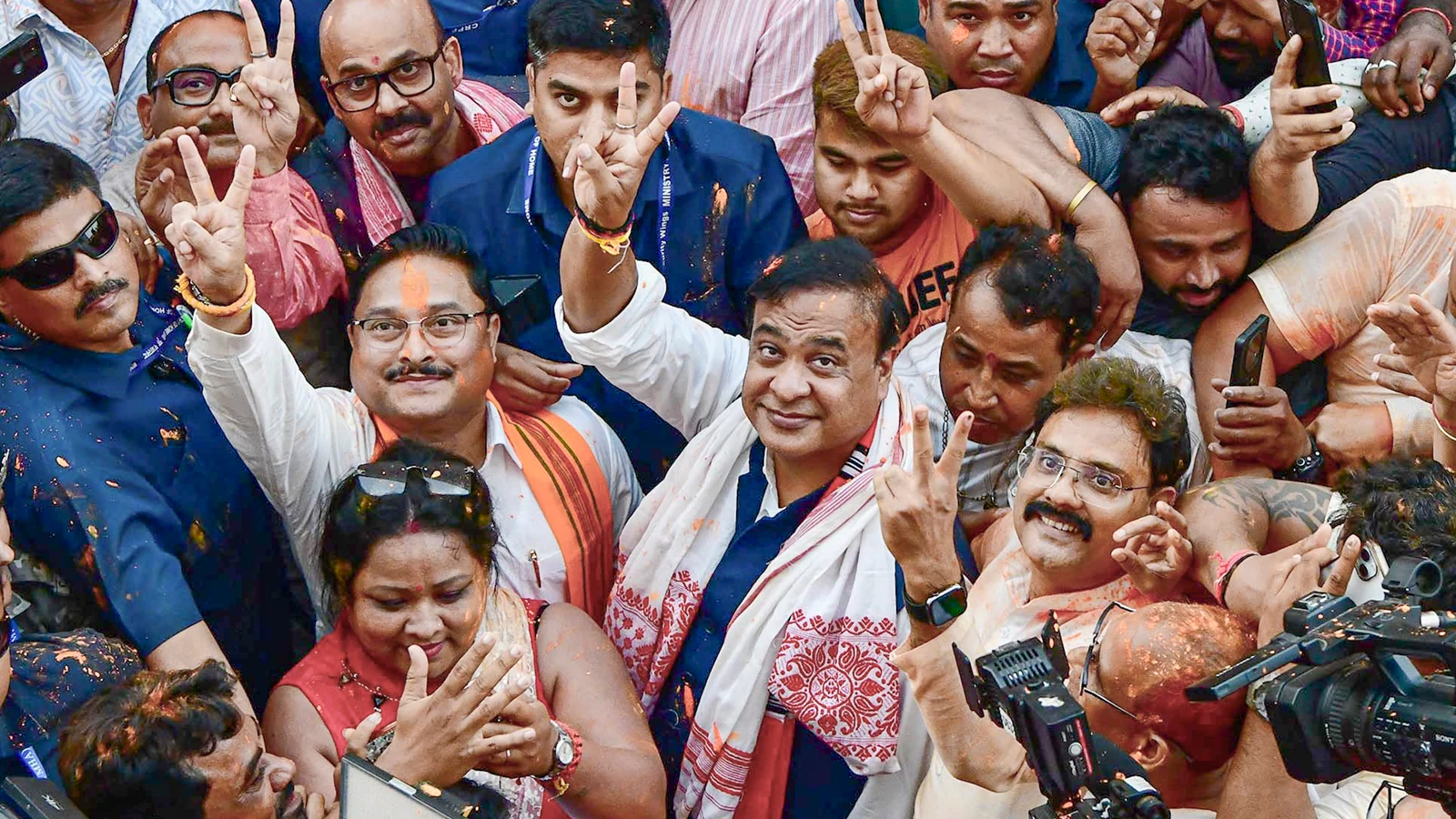
CM Himanta Biswa Sarma and othere celebrates BJP's victory in Assam Assembly elections (PTI)
Guwahati, 5 May
Of the 59
women candidates who contested the polls to the 126-member Assam Assembly, only
seven managed to win, the same as the 2021 results.
In the new
Assembly, the ruling NDA will have six women legislators, while the opposition
Congress has one. Women comprise 49.98 per cent of the total 2.50 crore
electorate in the state.
The BJP has increased the tally of its women MLAs to four, while its allies Asom Gana
Parishad (AGP) and Bodoland People's Front will have one each. Of the 14 women
candidates the Congress fielded, the highest among all parties, only one
managed to win.
The NDA is
set to form the government in Assam for the third consecutive term.
The most
prominent woman candidate to win the election is State Finance Minister Ajanta
Neog, who retained her Golaghat constituency for the sixth consecutive term.
The other
BJP candidates to win are its Mahila Morcha state unit chief Nilima Devi in
Mangaldoi and Niso Terangpi from Diphu.
The AGP's
Diptimayee Choudhury retained the Bongaigaon seat, while the BPF's Sewli
Mohilary won from Kokrajhar. The lone woman Congress candidate to win the seat
is first-timer Baby Begum from Dhubri.
Delimitation
key factor in NDA’s landslide win in Assam
The 2023
delimitation of assembly constituencies emerged as a major factor behind the
NDA’s sweeping victory in Assam, where it secured a record 102 out of 126
seats. The redrawing of boundaries reshaped electoral demographics, weakened
traditional vote banks, and strengthened the ruling alliance’s position.
How
Delimitation shifted the political balance
• Constituency redrawing in 2023
reduced the influence of minority strongholds in several traditional seats.
• Muslim-majority constituencies were
split and merged with indigenous-dominated areas.
• This led to dilution of minority vote
concentration in key regions.
Impact on the minority vote base
• Minority-dominated constituencies
reduced from 35 to fewer than 25.
• Opposition (Congress + AIUDF) strong
wins are largely confined to these 25 seats.
• Of 24 Opposition wins outside NDA
dominance, 22 were Muslim candidates.
Reservation
changes
The
delimitation kept the number of assembly seats the same at 126 but reserved more
constituencies for the Scheduled Tribe and the Scheduled Caste, with the former
being increased from 16 to 19 and the latter to nine from eight.
Barpeta
and Goalpara (West), seats having a significant number of Bengali-speaking
Muslims, were reserved for the Scheduled Caste and the Scheduled Tribe,
respectively, and the NDA wrested both from the Congress.
Bodoland
region impact
• Tribal reserved seats increased: 11 →
15.
• NDA ally BPF won 10 of these 15
seats.
• BPF’s only Muslim candidate lost.
NDA
performance
• NDA dominated reserved constituencies
overall.
• Even though AGP fielded 13 Muslim
candidates.
• NDA allies ensured majority gains in the reshaped constituencies.
Share Now

Leave a Reply
Your email address will not be published. Required fields are marked *
Other Stories


.jpg)