SC backs EC, dismisses TMC's plea on Central staff for Bengal vote counting
Polling for the 294-member West Bengal Assembly was held in two phases on 23 April and 29 April. Votes will be counted on 4 May.
PTI
-
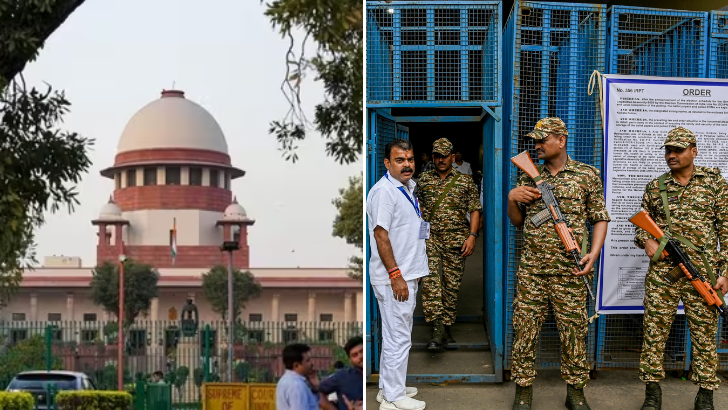
SC observed that the EC's circular, which provides for a mix of central and State govt employees in the counting process, was not contrary to law (PTI)
New Delhi, 2 May
The Supreme Court on Saturday declined to pass further
directions on a plea filed by Trinamool Congress (TMC) challenging the
deployment of central government personnel during vote counting in West Bengal
by the Election Commission (EC).
Effectively upholding the framework outlined by the poll
panel, a special bench comprising justices PS Narasimha and Joymalya Bagchisaid that the EC's 13 April circular, which provides for a mix of central and State
government employees in the counting process on 4 May, was not contrary to law.
It said that the poll body has the discretion to appoint
counting personnel from either pool.
"No further orders are necessary in this case except to
record the statement of Mr D Naidu,
appearing for the poll panel, that the Election Commission will implement the
circular dated April 13 in true letter and spirit. With this clarification, the
special leave petition stands dismissed," the bench said in its order.
Polling for the 294-member West Bengal assembly was held in
two phases on 23 April and 29 April. Votes will be counted on Monday.
In its 30 April judgment, the Calcutta High Court had
rejected the TMC's contention that the EC's directive was issued without
jurisdiction or based on vague apprehensions.
The high court also dismissed allegations that central
government or PSU employees could be influenced by the Union government, noting
the presence of multiple layers of oversight in the counting process. The TMC
rushed to the top court to appeal against the directive leading to the special
hearing on a Saturday, a court holiday.
During the hearing, the poll panel said the apprehensions of
TMC of any wrongdoing is misplaced, as the circular very clearly states that
there will be a mix of central and State government employees.
The EC assured the court that the circular would be
implemented in letter and spirit, and there would be state government employees
also during the counting.
At the outset, senior advocate Kapil Sibal, appearing for
the TMC, said the circular was dated 13 April, but they came to know about it
on 29 April.
He said there are four issues: One, the circular appointing
Central employees was issued to DEOs on April 13, but came to their knowledge
only on April 29; Two, the Election Commission says it has apprehensions of
irregularity, despite having a Central nominee in the counting process; Three,
the poll body already has a Central government officer at each counting table
in the form of a micro observer, and four, the commission has not appointed
state nominees even though the circular provides so.
Sibal submitted that the Chief Electoral Officer's
communication states that there are apprehensions expressed from various
quarters regarding possible irregularities in counting. "That is like
pointing a finger at the state government...," Sibal said, adding,
"There must be some data. Where is (the proof of) the apprehension
(raised) from each booth? They have not disclosed this. And why not tell us
that they are going to have a Central government nominee?"
The bench told Sibal that even if the EC's circular had provided
for the appointment of central employees as both the counting supervisor and
the counting assistant, the court could not have faulted the decision.
"The option is open for the Election Commission:
whether the counting supervisor and assistant may be of the Central or the State government. When that option is open, we cannot hold that the
notification is contrary to regulations. Even if the EC says that both of them
can be Central government employees, we could not have faulted them. Because
regulations say that either the Central government or state government officers
can be appointed," Justice Bagchi told Sibal.
Sibal then submitted that the court may ask the EC to follow
the impugned circular in its entirety, which provides for a State government
nominee.
"All we want is, in terms of the circular, the state
government nominee should be there," he said.
Justice Bagchi asked if he wants compliance with the
circular, then why is the TMC before the court.
Senior advocate DS Naidu, appearing for the EC, submitted that
the returning officer is a State government employee with overarching power to
deploy personnel from any pool of government employees. "We are saying
that there will be state government employees during the counting of
votes," Naidu submitted, adding that each candidate will also have their
own counting agent.
"The TMC's apprehension of any wrongdoing is completely
misplaced," he reiterated.
The bench then disposed of the plea, saying that no further
order is necessary and reiterated that the Election Commission will follow its
circular in letter and spirit.
The Calcutta High Court had not agreed with the TMC's
allegation that its main opponent, the BJP, controls the employees of the
central government or PSUs, making them susceptible to suggestions and control
by the Union government.
It had also noted that apart from the counting supervisors
and assistants, micro-observers, counting agents of candidates and other
personnel would also be present in the counting hall.
Share Now

Leave a Reply
Your email address will not be published. Required fields are marked *
Other Stories