PM Modi speaks to leaders of Jordan, France, Oman, Malaysia; India calls West Asia energy strikes ‘unacceptable’
Modi said the attacks on energy infrastructure in West Asia are "condemnable and can lead to avoidable escalation".
PTI
-
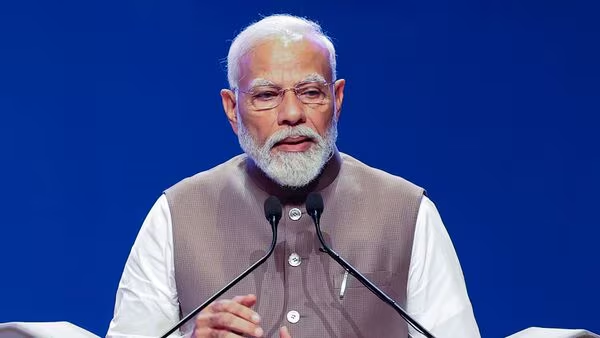
Narendra Modi said that India and Oman stand for safe and free navigation through the Strait of Hormuz (PTI)
New Delhi, 19 Mar
As fresh attacks on West Asian gas hubs triggered global concerns,
India on Thursday said the strikes are "unacceptable and need to
cease" even as Prime Minister Narendra Modi reached out to top leaders of
Oman, Jordan, France and Malaysia, emphasising the urgency to restore peace in
the volatile region.
Following
his phone conversation with Jordan's King Abdullah II, Modi said the attacks on
energy infrastructure in West Asia are "condemnable and can lead to
avoidable escalation".
New Delhi
described the attacks on the gas infrastructure as "deeply
disturbing" and that assaults will only serve to further destabilise an
already uncertain energy market globally.
An Israeli
attack on Iran's strategic gas fields of South Pars on Wednesday resulted in an
intense Iranian retaliation on key energy infrastructure in a number of Gulf
nations including Qatar's LNG (liquefied natural gas) hub of Ras Laffan. Qatar
accounts for nearly 40 per cent of India's LNG requirement.
"India
had previously called for the avoidance of targeting civilian infrastructure,
including energy infrastructure, across the region," External Affairs
Ministry spokesperson Randhir Jaiswal said at his weekly media briefing.
"The
recent attacks against energy installations in different locations across this
region are therefore deeply disturbing and only serve to further destabilise an
already uncertain energy scenario for the whole world," he said.
"Such
attacks are unacceptable and need to cease," Jaiswal said without naming
any country.
The fresh
attacks resulted in further spike in energy prices globally with global crude
oil prices hitting USD 115 a barrel.
As
concerns mounted over the escalating situation in West Asia, PM Modi spoke to
Oman's Sultan Haitham bin Tariq, Jordan King, French President Emmanuel Macron
and Malaysian Prime Minister Anwar Ibrahim.
In his
conversation with the Omani Sultan, Modi also spoke about the need for free
passage through the Strait of Hormuz, a strategically key shipping lane.
"We
agreed on the need to prioritize dialogue and diplomacy for de-escalation and
subsequent restoration of peace and stability," the prime minister said on
social media.
Modi said
he also reiterated India's condemnation of the violation of Oman's sovereignty
and territorial integrity and appreciated the Gulf nation's efforts to
facilitate the safe return of thousands of people, including Indian nationals.
"India
and Oman stand for safe and free navigation through the Strait of Hormuz,"
Modi said.
Oman is
among the Gulf nations bearing the brunt of Iranian retaliation following
strikes by Israel and the US on Iranian targets.
Following
his phone conversation with Macron on the situation in West Asia, Modi said
there is an "urgent need for de-escalation, as well as a return to
dialogue and diplomacy".
"We
look forward to continuing our close coordination to advance peace and
stability in the region and beyond," he said.
Macron
said India and France are "working closely together to reduce tensions in
the region and to keep diplomacy at the heart of our efforts for peace".
After
speaking to Ibrahim, Modi said: "We also discussed the deeply concerning
situation in West Asia and reaffirmed our shared commitment to de-escalation
and the early restoration of peace and stability through dialogue and
diplomacy."
On his
talks with Jordan King, Modi said India and Jordan stand in support of
"unhindered transit of goods and energy".
"We
expressed concern at the evolving situation in West Asia and highlighted the
need for dialogue and diplomacy for the early restoration of peace, security
and stability in the region," Modi said.
"Attacks
on energy infrastructure in West Asia are condemnable and can lead to avoidable
escalation," he said.
"Deeply
appreciated Jordan's efforts in facilitating the safe return of Indians
stranded in the region," he added.
As the
overall situation deteriorated further in West Asia, several global leaders
called for de-escalation of the situation.
"It
is time to open a path towards de-escalation in order to restore stability in
the Middle East," French President Macron said.
"France
calls for the immediate implementation of a moratorium on strikes targeting
civilian infrastructure, whether related to water or to energy. Freedom and
security of navigation must be restored," he said.
Macron
said tempers must cool and hostilities must cease, in order to give a real
chance to the prospect of a negotiated solution to the crisis.
German
Chancellor Friedrich Merz indicated that US President Donald Trump is willing
to halt the military action.
After Iran
attacked Qatar's Ras Laffan LNG facility, Trump threatened to blow up Iran's
largest gas field if Tehran keeps up its attacks on Qatar.
Share Now

Leave a Reply
Your email address will not be published. Required fields are marked *
Other Stories