
Govt bars LPG cylinders for households with PNG connections
Amended order bars oil companies from issuing LPG connections or refilling cylinders for households with PNG supply.
PTI
-
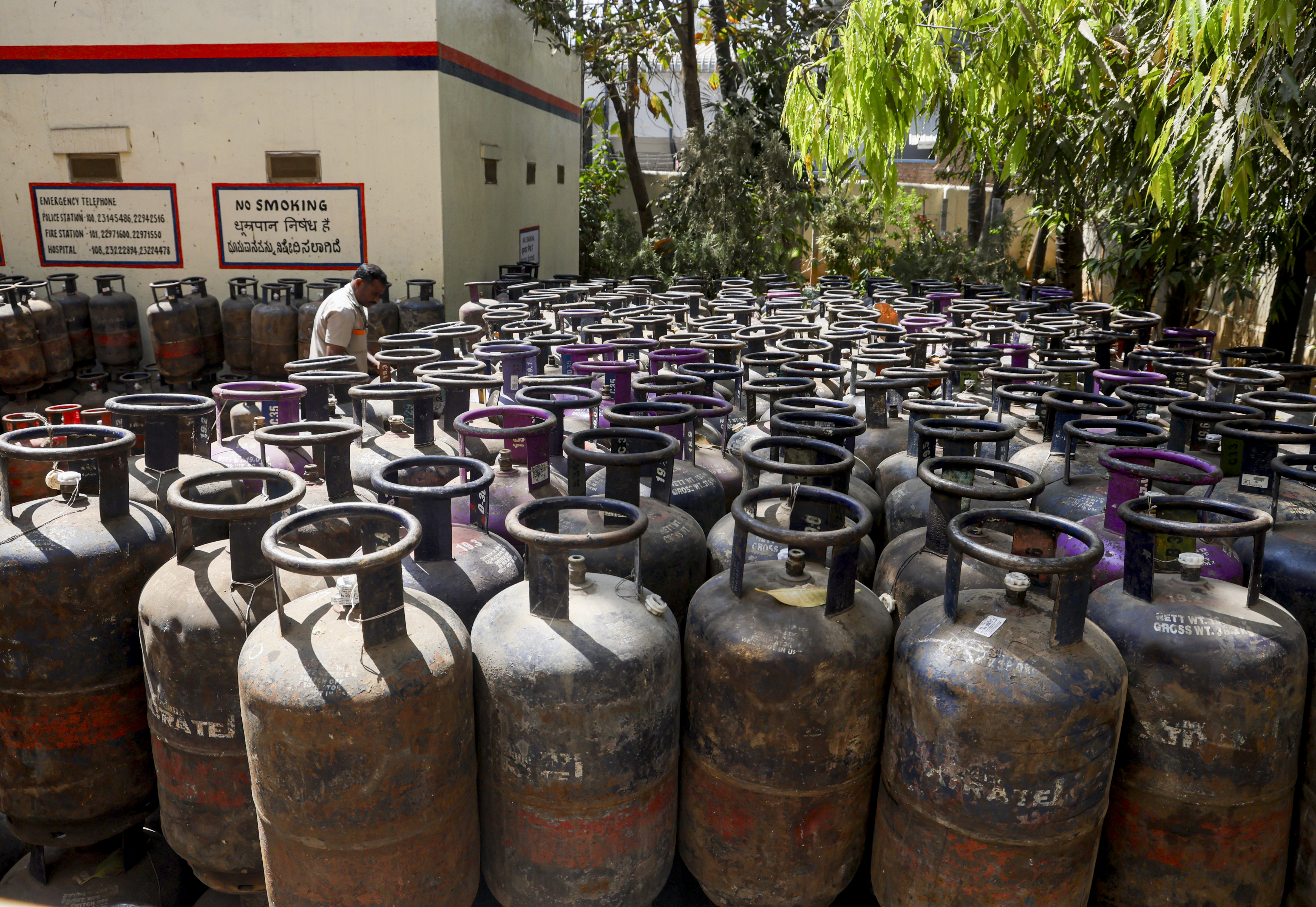
The move is aimed at prioritising LPG supplies for households that do not have access to piped gas (PTI)
New Delhi, 15 Mar
The government has barred households with piped cooking gas (called PNG) connections from retaining or obtaining subsidised domestic LPG connections, even as the sector regulator pushed city gas distributors to accelerate PNG rollout to ease pressure on cooking gas supplies amid global energy supply disruptions.
In
a notification issued on 14 March, the Ministry of Petroleum and Natural Gas
amended the Liquefied Petroleum Gas (Regulation of Supply and Distribution)
Order, 2000, under the Essential Commodities Act, making it mandatory for
consumers with PNG connections to surrender their domestic LPG connections.
The
amended order also prohibits government oil companies and their distributors
from providing domestic LPG connections or refilling cylinders for consumers
who already have a PNG supply.
"No
person having a piped natural gas (PNG) connection and also having a domestic
LPG connection shall retain a domestic LPG connection, or take refills of
domestic LPG cylinders from any Government oil company, or through their
distributors. Such persons will be required to immediately surrender their
domestic LPG connection," the order said.
Those
having PNG connections have also been barred from obtaining a domestic LPG
connection.
For
government oil companies, the order prohibited them from "providing a
domestic LPG connection, and/or supplying domestic LPG cylinder refills to a
consumer who already owns a PNG connection".
The
move is aimed at prioritising LPG supplies for households that do not have
access to piped gas.
India
imports about 88 per cent of its crude oil, 50 per cent of its natural gas and
60 per cent of its LPG needs. Before the US-Israel strikes on Iran on 28 February and Tehran's retaliation, more than half of India's crude imports, about 30
per cent of gas and 85-90 per cent of LPG imports came from West Asian
countries, such as Saudi Arabia and the UAE.
The
conflict has led to a blockade of the Strait of Hormuz, the main transit route
for Gulf energy supplies. While India has partly offset crude supply disruptions
by sourcing oil from countries, including Russia, gas supplies have been
curtailed to industrial users and LPG availability to commercial
establishments, such as hotels and restaurants, has been reduced.
In
a related advisory, the Petroleum and Natural Gas Regulatory Board (PNGRB) has
asked city gas distribution (CGD) companies to expedite the conversion of
households to domestic PNG (DPNG) and prioritise consumers in areas where
pipeline infrastructure has already been laid.
The
regulator said India's total natural gas consumption is around 189 million
metric standard cubic metres per day (mmscmd), of which about 97.5 mmscmd is
produced domestically.
Out
of the average 13.94 mmscmd of administered price mechanism (APM) gas allocated
to the CGD sector, about 3.63 mmscmd is used in the domestic PNG segment, while
the rest is consumed in the compressed natural gas (CNG) segment for vehicles.
As
of 31 January 2026, CGD entities have reported about 1.65 crore PNG
connections, of which 1.03 crore consumers are actively using the fuel.
The
regulator said CGD companies should prioritise providing PNG connections to
consumers who have registered for the service or whose residential areas
already have pipeline infrastructure, as this would help reduce pressure on LPG supply chains and support diversification of cooking fuel.
Companies
have also been asked to accelerate the rollout of PNG infrastructure, deploy
additional manpower and equipment, and shorten the time between application and
commencement of gas supply to households.
PNGRB
said closer coordination with state governments, municipal bodies and local
authorities would be critical to secure permissions, speed up approvals and
ensure faster last-mile connectivity for PNG networks.
The
regulator added that expanding PNG coverage would support India's energy
transition by increasing access to cleaner fuels and mitigating supply
disruptions caused by global geopolitical developments.
Share Now

Leave a Reply
Your email address will not be published. Required fields are marked *
Other Stories




.jpg)