Don’t fear AI; it’s only aid, not substitute: CJI Surya Kant
CJI said AI in courts must balance efficiency gains with preserving human judgment, experience and constitutional values.
PTI
.png)
-
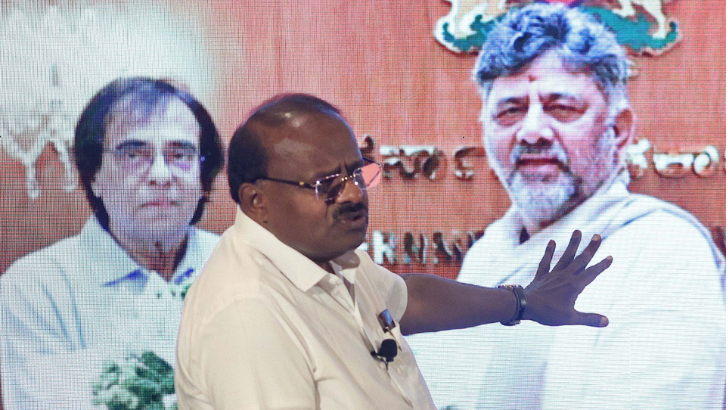
CJI Surya Kant said technology must be approached with discernment, not deference (Mohammed Asad)
Bengaluru, 18 April
Cautioning that the adoption of technology in the judiciary must be accompanied by a clear and conscious understanding of its inherent limitations, Chief Justice of India Surya Kant on Saturday urged judicial officers not to be "afraid" of AI.
Asserting
that technology must remain an aid, not a substitute, he said the integration
of Artificial Intelligence into the judicial process must be guided by a
principle of balance—leveraging its benefits to enhance efficiency while
steadfastly preserving the human intellect, experience, and constitutional
conscience that lie at the heart of justice.
The chief
justice was speaking at the 22nd biennial state-level conference of judicial
officers, themed 'Reimagining the Judiciary in the Era of Artificial Intelligence', organised by the Karnataka State Judicial Officers Association.
"I
would also like to add that you should not be afraid of AI. What do you do when
a case involving very complicated facts and complex questions of law is placed
before you? You apply more thought, spend more time, exercise greater patience,
and feel a sense of satisfaction when you decide such a case," Justice
Kant said.
"The
same will happen with AI tools when we begin using them carefully and
consciously, ensuring that the judge within you remains independent and is not
influenced by these technical tools," he added.
Karnataka Chief Minister Siddaramaiah, Supreme Court judges BV Nagarathna and Aravind
Kumar, and Chief Justice of the Karnataka High Court, Vibhu Bakhru, among
others, were present at the event.
Stating
that the emergence of AI presents both significant opportunities and serious
challenges for the judiciary, the CJI said that, on one hand, AI has the
potential to enhance efficiency in meaningful ways—by assisting in legal
research, streamlining case management, organising large volumes of data, and
reducing administrative burdens that often consume valuable judicial time.
"With
structured and targeted training, judicial officers can effectively harness
these tools to improve productivity and ensure that greater time and attention
are devoted to the core function of adjudication," he said.
However,
he added, the adoption of such technology must be accompanied by a clear and
conscious understanding of its inherent limitations.
"AI
operates on patterns, algorithms, and existing datasets; it does not possess
judgment in the human sense, nor can it engage with the ethical, social, and
moral dimensions that frequently underpin judicial decision-making,"
Justice Kant said.
"The
process of judging is not merely analytical—it is also reflective, contextual,
and guided by constitutional values. An over-reliance on AI tools risks
reducing this nuanced exercise to a mechanical output, thereby diluting the
depth, independence, and integrity of judicial reasoning," he said.
Expressing
concern about inaccuracies generated by such systems, he said there have been
recent instances of fabricated precedents, incorrect citations, and entirely
fictitious legal propositions being produced by AI platforms.
"These
so-called ‘hallucinations’ are not minor technical lapses; they strike at the
very foundation of the judicial process, which rests on accuracy, authenticity,
and trust. If left unchecked, they have the potential to mislead, distort legal
arguments, compromise the quality of adjudication, and misdirect
outcomes," he said.
Justice Kant further warned of the growing risk of AI tools being misused to generate
misleading pleadings, frivolous claims, or superficially convincing yet
substantively flawed submissions.
"Such
practices not only burden the judicial system but also divert attention from
genuine disputes that require urgent resolution. In an already strained system,
this adds a layer of complexity that must be addressed seriously," he
said.
Highlighting
the role of judicial officers in this evolving landscape, the CJI said,
"Technology must be approached with discernment, not deference."
Any
material generated through AI must be subjected to scrutiny and independent
verification, he said, adding, "The responsibility to ensure accuracy,
authenticity, and fairness cannot be delegated to a machine. It remains an
essential and non-negotiable component of judicial duty."
He
emphasised that while navigating this evolving landscape, it is necessary to
reaffirm a foundational principle—that justice is, and must remain, a human
endeavour.
"It
is shaped by reasoning, guided by values, and enriched by experience, and no
technological advancement can replicate the intuitive understanding and moral
judgment at the core of judicial decision-making," he said.
The CJI
said the future of the judiciary will be shaped by its ability to adapt without
losing its core identity.
This
requires continuous learning, reflection, and a commitment to excellence, he
added.
"We
stand at a moment of transition, where the choices we make will define the
trajectory of the judiciary for years to come. While our tools and methods may
evolve, our fundamental responsibility remains unchanged—to deliver justice
that is fair, accessible, and humane," he said.
Highlighting
that there are moments in the life of an institution when introspection becomes
indispensable, the CJI said the time to pause and introspect has arrived for
the Indian judiciary.
A time
comes when it must pause—not out of hesitation, but out of
responsibility," he added.
Share Now

Leave a Reply
Your email address will not be published. Required fields are marked *
Other Stories